IKEv1 vs IKEv2: Why It's Time to Upgrade Your VPN Security
2026
Site-to-site VPN tunnels and remote access connections remain an important part of many organizations’ network infrastructure. They connect offices, partners, external environments and remote users.
Yet some of these connections still rely on IKEv1, a key exchange protocol dating back to 1998.
In June 2026, a critical and actively exploited vulnerability in IKEv1 showed why keeping this legacy protocol enabled is no longer a harmless compatibility choice. It can introduce a real VPN security risk.
For organizations still using IKEv1, migrating to IKEv2 is therefore not simply a technical upgrade. It is part of maintaining a secure and up-to-date network infrastructure.
What Is IKEv1?
IKE, or Internet Key Exchange, is the protocol used to establish an IPsec VPN tunnel. It authenticates both sides of the connection and negotiates the encryption keys that protect the traffic.
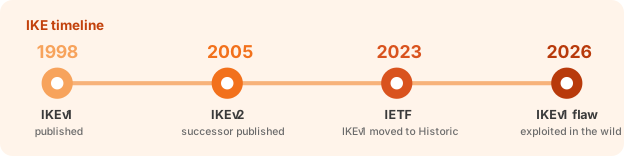
IKEv1 was published in 1998.
Its successor, IKEv2, was published in 2005. In 2023, the IETF officially deprecated IKEv1 and moved it to Historic status.
IKEv1 has therefore stopped evolving, while attackers continue to look for vulnerabilities in systems where the legacy protocol remains enabled.
When Legacy VPN Technology Becomes a Security Risk
In June 2026, a major firewall vendor released an urgent hotfix for a critical vulnerability with a CVSS score of 9.3 in deprecated IKEv1 code used in remote access VPN solutions.
The impact was significant:
- an unauthenticated attacker could establish a VPN session without a valid password;
- the vulnerability was actively exploited in the wild from May 2026;
- the attacks were linked to a ransomware group.
The lesson extends beyond one specific firewall vendor.
A deprecated protocol generally receives less development attention while often remaining enabled for compatibility reasons. This combination can turn legacy functionality into an unnecessary attack surface.
This is where VPN vulnerability management becomes important.
Organizations should continuously match newly disclosed vulnerabilities against their firewalls and VPN gateways, prioritize vulnerabilities based on severity and active exploitation, and follow remediation until every necessary patch or configuration change has been completed.
Without this process, a critical VPN vulnerability could remain present for weeks without being detected.
IKEv1 vs IKEv2: What's the Difference?
IKEv2 is not simply a newer version of IKEv1. It was designed to address several weaknesses of its predecessor.
|
|
IKEv1 |
IKEv2 |
|
Protocol status |
Legacy / Historic |
Current successor |
|
Security |
Older protocol architecture |
Support for modern cryptographic algorithms |
|
DoS protection |
More limited |
Improved protection against denial-of-service and amplification attacks |
|
Reliability |
NAT-T and DPD through separate extensions |
NAT traversal and liveness checks built into the protocol |
|
Efficiency |
More message exchanges |
Fewer messages required to establish a tunnel |
|
Development |
Deprecated |
Actively maintained by vendors |
-
Stronger VPN security
IKEv2 offers better protection against denial-of-service and amplification attacks and supports modern cryptographic algorithms.
-
Greater reliability
Built-in NAT traversal and liveness checks help create more stable VPN connections.
-
More efficient connections
IKEv2 requires fewer messages to establish a tunnel.
-
Better long-term support
While IKEv1 has been moved to Historic status, vendors continue to maintain and develop support for IKEv2.
For organizations reviewing their IPsec VPN security, these differences make IKEv2 the preferred protocol for modern VPN environments.
How to Migrate from IKEv1 to IKEv2
Switching a VPN tunnel from IKEv1 to IKEv2 can appear to be a small technical configuration change.
In practice, careful preparation is required.
1. Inventory existing IKEv1 tunnels
Identify all site-to-site VPN tunnels and remote access configurations that are still using IKEv1. This inventory provides a clear overview of where the legacy protocol remains active.
2. Coordinate with the other side of the VPN tunnel
A site-to-site VPN tunnel only works when both parties use compatible configurations. Migration therefore needs to be coordinated with the organization or partner on the other side of the connection.
3. Check encryption domains
IKEv2 negotiates networks more strictly than IKEv1. Overlapping or inconsistent definitions can therefore cause connectivity issues during migration.
4. Plan and test the migration
Migrate VPN tunnels individually during a planned maintenance window. Each change should have a test procedure, validation steps and a rollback plan.
The most common obstacle is often not technical, but organizational: coordinating the change with the partner at the other end of the VPN connection.

IKEv1, VPN Security, NIS2 and CyberFundamentals
Replacing outdated or unnecessary protocols is also relevant from a wider cybersecurity and compliance perspective.
In Belgium, the NIS2 law relies on the CyberFundamentals (CyFun®) 2025 framework of the Centre for Cybersecurity Belgium as a reference for cybersecurity measures.
Migrating from IKEv1 to IKEv2 supports several of its requirements:
- PS-01.3 — identifying and disabling protocols and services that are not required;
- DS-02.2 — protecting critical and sensitive information in transit;
- AA-03.2 — requiring multi-factor authentication for remote access;
- AM-03.3 — mapping and documenting external network connections;
- RA-08.1 — managing vulnerabilities through a defined process, including actively exploited vulnerabilities.
For IT teams, replacing IKEv1 therefore supports both stronger network security and a more structured approach to cybersecurity risk management.
Why Organizations Should Phase Out IKEv1
IKEv1 is no longer simply an old VPN setting that can safely remain enabled indefinitely. It represents an additional attack surface.
Migrating from IKEv1 to IKEv2 can help organizations:
- close a known and actively targeted attack vector;
- strengthen VPN security;
- improve the stability of VPN connections;
- align network infrastructure with current standards;
- support NIS2 and CyberFundamentals requirements.
Do you know which of your VPN tunnels still use IKEv1?
That is a question worth answering before a vulnerability turns an overlooked legacy configuration into a security incident.
Want to learn more about NIS2? Read our practical NIS2 guide for IT professionals.
Frequently Asked Questions About IKEv1 and IKEv2
IKEv1 is a legacy protocol that has been moved to Historic status by the IETF. Keeping unnecessary IKEv1 configurations enabled can increase the attack surface of VPN infrastructure, particularly when vulnerabilities are discovered in legacy implementations.
IKEv2 is the successor to IKEv1. It provides stronger security capabilities, improved reliability, more efficient tunnel establishment and continued vendor support.
Organizations should first identify where IKEv1 is still being used and determine whether those connections can be migrated. Unnecessary legacy protocols should not remain enabled purely for compatibility if they are no longer required.
Start by inventorying existing tunnels, coordinating with external VPN peers, checking encryption domains and migrating tunnel by tunnel during planned maintenance windows with testing and rollback procedures.
IKEv2 was designed to address weaknesses in its predecessor and supports modern cryptographic algorithms, improved DoS protection and more robust VPN operation.
Migrating away from unnecessary legacy protocols supports CyberFundamentals measures related to secure communications, vulnerability management, remote access and documenting external network connections.
October 2026
Nicolas Dricot