Microsoft Teams Direct Routing with Oracle SBC
OCTOBER 23, 2026
Why Oracle SBC for Teams Direct Routing ?
Microsoft Teams has become a central communication platform for many organizations.
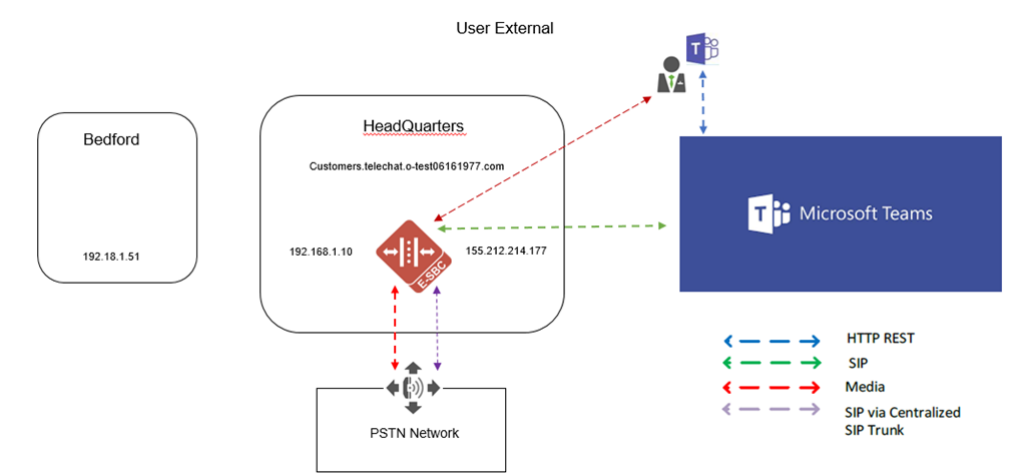
Microsoft Teams Direct Routing allows organizations to connect Teams Phone to external providers through a certified SBC.
With Direct Routing, organizations can maintain connectivity to PSTN / SIP providers, number management, routing logic, and interoperability with existing voice infrastructure.
Oracle SBC is certified for Microsoft Teams Direct Routing and provides a secure and flexible integration layer between Teams and telephony infrastructure.
This allows organizations to:
- Keep existing telecom providers
- Maintain provider independence
- Integrate legacy PBX systems
- Support hybrid voice environments
- Centralize routing and call control
Oracle SBC becomes the bridge between Teams and the outside voice world.
More Flexibility Than Operator-Based Calling
Many organizations want to avoid being locked into a single calling provider.
Direct Routing with Oracle SBC provides more control over voice architecture.
Organizations can:
- Connect multiple SIP providers
- Build failover between carriers
- Route calls based on policy
- Maintain existing numbering plans
- Integrate local PSTN requirements
This creates a more flexible and future-proof Teams telephony environment.
Local Media Optimization
Oracle SBC also supports Microsoft Teams Local Media Optimization (LMO).
Local Media Optimization allows enterprises to control how media flows between Teams clients and Oracle SBCs while improving voice quality and reducing unnecessary media traversal.
In other words, this feature allows media traffic to stay closer to the user instead of always flowing through a centralized location.
This creates advantages such as:
- Lower latency
- Improved call quality
- Reduced bandwidth usage
- Better regional media handling
Oracle documents multiple deployment models, including centralized and regional SBC architectures, allowing media to remain local whenever possible.
Oracle SBC and Teams Interoperability
Oracle SBC includes features specifically designed for Teams interoperability.
Examples include:
- TLS-secured SIP signaling
- SRTP media encryption
- Teams-specific SIP normalization
- ICE-Lite support for media bypass
- Realm-based routing policies
- Teams FQDN handling for Direct Routing
These capabilities simplify integration and reduce the need for complex SIP manipulation.
Oracle documentation also highlights newer Teams-focused parameters that reduce manual SIP normalization complexity when integrating Direct Routing environments.
-
Conclusion
Oracle SBC extends Microsoft Teams beyond collaboration by enabling enterprise-grade telephony integration.
Through Direct Routing, organizations gain flexibility, provider independence, and advanced voice control.
Oracle SBC can also be used in broader cloud telephony and UC environments, including integrations around platforms such as Zoom Phone, Cisco Webex Calling, ALE Rainbow, and many other SIP-based UCaaS or CCaaS services. The common principle remains the same: the SBC provides a controlled, secure, and interoperable layer between the enterprise voice environment, telecom providers, and cloud communication platforms.
Combined with Quant ICT expertise, Oracle SBC allows businesses to build a Teams voice environment designed for performance, security, and long-term scalability.
This concludes the SBC article series.
Across this series, we explored how SBC technology supports security, interoperability, routing, monitoring, and media handling, and how Oracle SBC supports Microsoft Teams Direct Routing - helping organizations create modern communication architectures built for the future.
October, 2026
Steven Deferme